Sick Around the World
These materials have disappeared from PBS and other official websites. I preserve and summarize them here as an unofficial record of their important findings. RR (2026)
This PBS Frontline Documentary from 2008 explores the healthcare systems of the U.S. and several comparable countries.[1] The corespondent T.R. Reid visited five capitalist countries that provide affordable, nearly universal coverage for their citizens. How do they do it? He observed that here in the U.S. we have the British model for veterans (socialized medicine), the Taiwanese model for seniors (single payer), the German model for some workers (private insurance), but for the rest we are “just another poor country”. His conclusions…
- Insurance companies must accept everyone, and cannot make a profit on basic care.
- Everybody is mandated to buy insurance, with government paying the premiums for the poor.
- Doctors and hospitals have to accept one standard set of fixed prices.
Five Healthcare Systems
This is my summary of the analysis accompanying Sick Around the World
, which is no longer available online.[2]
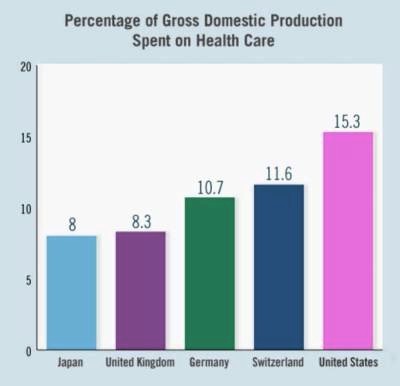
| Criteria | Japan | United Kingdom | Germany | Switzerland | United States |
|---|---|---|---|---|---|
| % 2007 GDP | 8% | 8.3% | 10.7% | 11.6% | 15.3% |
| type | social insurance† | fully socialized | social insurance | social insurance | mixed |
| required | yes | yes | yes, except top 10% | yes | no |
| avg/mo premium | $280 | $0 | $750 | $750 | $0-$1000s |
| employers pay | 50% | 0% | 0% | 0% | varies |
| gov subsidies | low income caps | 100% | low income | low income | 0-100% |
| price controls | yes, gov | yes, gov | yes, insurers | yes, insurers (gov for drugs) | varies |
| private/public | private | public | private | private | mix |
| gatekeepers | no | yes, GP | yes | no | mix |
| medical bankruptcy‡ | none | none | none | none | common |
† Social Insurance details vary, but they all include coverage mandates with subsidies for the poor, prohibitions on cherry picking by insurers, and recurring negotiations of prices. All are non-profit or place limits on profits.
‡ A comprehensive study conducted in 2018 found that 62% of bankruptcies are due to medical bills and, of those, 75% were insured at the time.[3] Not part of original website.
The following paragraphs are reproduced here as they appeared on the PBS website.[2]
Japan boasts some of the best health statistics in the world, no doubt due in part to the Japanese diet and lifestyle. Unlike the U.K., there are no gatekeepers; the Japanese can go to any specialist when and as often as they like. Every two years the Ministry of Health negotiates with physicians to set the price for every procedure. This helps keeps costs down.
German Sickness Funds [social insurance] are nonprofit and cannot deny coverage based on preexisting conditions; they compete with each other for members, and fund managers are paid based on the size of their enrollments. Like Japan, Germany is a single-payment system, but instead of the government negotiating the prices, the sickness funds bargain with doctors as a group. Germans can go straight to a specialist without first seeing a gatekeeper doctor, but they may pay a higher co-pay if they do.
The Swiss example shows that universal coverage is possible, even in a highly capitalist nation with powerful insurance and pharmaceutical industries. Insurance companies are not allowed to make a profit on basic care and are prohibited from cherry-picking only young and healthy applicants. They can make money on supplemental insurance, however. As in Germany, the insurers negotiate with providers to set standard prices for services, but drug prices are set by the government.
- [1]
Sick Around The World
, PBS Frontline, April 15, 2008,Correspondent T.R. Reid examines first-hand the health-care systems of other advanced capitalist democracies — UK, Germany, Switzerland, Japan, and Taiwan — to see what tried and tested ideas might help us reform our broken health-care system.
Original video taken down and now appears to exist only on Youtube. https://www.youtube.com/watch?v=h4rg-DJBd34, accessed Sept 2025. - [2]
Five Capitalist Democracies & How They Do It
, https://www.pbs.org/wgbh/pages/ frontline/sickaroundtheworld/ countries/, accessed Sept 2025, no longer available - [3]
The Case for Universal Health Care
, https://health.usnews.com/health-care/ for-better/articles/ the-case-for-universal-health-care, accessed March 2025