My First Hammock Tent
Ten Year Anniversary Edition
Richard Rathe, January 2016 (Reviews, Technology)
I went out last night to get some experience pitching and sleeping in my new hammock tent. It came with no instructions and there is only limited info available online. I’m getting better using a bit more tension and added a small relieving line to the fly so it can hang along the side (keeping the netting clear for viewing the trees and stars!). In future I’ll keep it rolled so it stays off the ground. I paddled in the dark to a place I’d picked out. Once you find two trees the rest is pretty easy. In fact, it’s trip-over-a-log easy compared with a surface tent! Plus everything stays dry!

I called this placemy islandbecause it was surrounded by water and I was unlikely to be disturbed. The ground has several cypress knees poking up so it would be difficult to place a tent on the ground—also very damp. It was a good place to test a hammock tent.
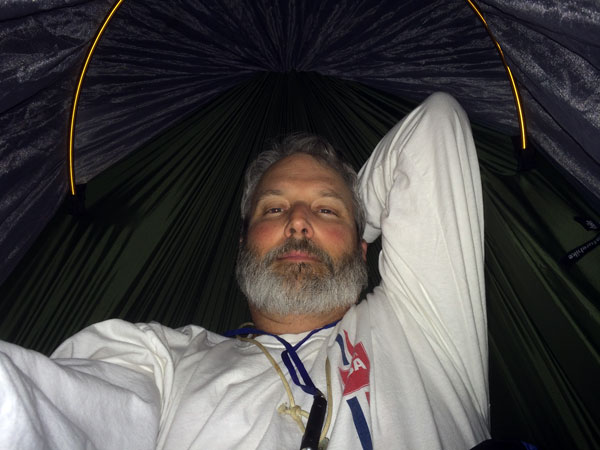
I brought a small towel to wipe my feet before swinging them inside. I like the little pouch on the outside for a water bottle and miscellaneous small stuff. There is also a small pocket in the netting overhead that works well for phone and glasses. One cool thing about all/most of these tents is the way they pack up, basically two narrow funnel-shaped sleeves (called “snakeskins”) that pull to the center. Take down is as easy as setting up.
Alas, none of my other hammocks is this easy. I don't understand why? Packing and unpacking is SO EASY withskinsit is hard to justify any other system. My much newer high-end hammock has the stuff sack integrated on one end, but the fly is a nightmare to deploy and take down.
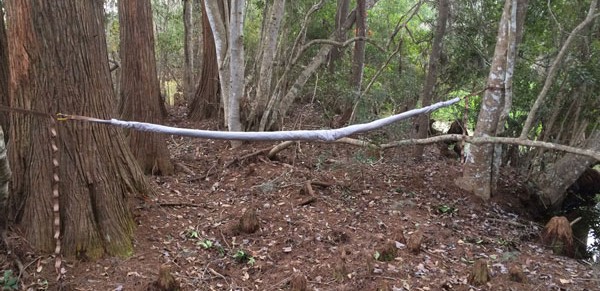
The diamond-shaped rainfly has wings
that tie out sideways. I think this will work well, but you have to stoop to enter/exit. Having recently pitched a conventional tent in driving rain (i.e., everything wet), it strikes me that the above arrangement is far superior. When you hang it and pull back the skins the fly is on top and drapes over the inner tent keeping it mostly dry. That’s the theory anyway!
This has proven to be true. After hanging the packed hammock you can quickly shake out the fly and get it staked. From that point forward you can leisurely work out of the rain, even cook if needed. The actual sleeping area inside the hammock stays mostly dry.
Update: I slept under the fly during a vigorous rain storm and it was amazing! Not one drop of water got through to me!! It was the driest tent I’ve ever experienced. The only caveat is the rain that night was mostly straight down. It would be a bit more vulnerable with a significant crosswind.
The fly on this tent is a large diamond shape (10x10 ft) with only two tie down points. It will flap and billow in the wind if you let it. Better flies have what is called acatenary cut—basically curved edges that prevent flapping. See my Hammock Camping Guide for more thoughts on this and other related topics.